Liebe Leser,
ja, ich weiß, ich habe diesen Blog schädlich vernachlässigt. An Themen lag es eigentlich nicht. Aber nun ist es hier erstmal vorbei - ich bereite meine Themen nämlich nun im Magazin von MOSÁICO Zementfliesen auf.
Hier ist mein erster Beitrag: https://www.zementfliesen.com/magazin/gaudi-fliesen-designklassiker/
Ich hoffe wir sehen uns dort!
Dear readers,
if you are interested to read in German, you can find my texts about art, history, pattern etc. in the "Magazin" of MOSÁICO Zementfliesen - see above link.
Hope to see you there!
Saturday, June 27, 2020

Tuesday, December 29, 2015
Tile research in Valencia: part II - the Nolla factory and "palace" in Meliana
After I read about the factory in Meliana, I had to go there of course, to see what is left of it. There is a metro station "Meliana" and from the train I could already see the "castle".
The factory was built in 1860 and began to work from 1864/65.

In this old photo you can see the bottle-shaped kilns. The factory walls still stand today, the belong to Schneider Electrics, who did not let me get onto their premises.


So I walked all around it, until I came to the "palauet Nolla", the palace-showroom, where Miguel Nolla received his most important clients. The building is now in ruins and - of course - fenced off.


On the façade you can see the portrait of the founder, the picture that was also used as title of the exhibition (see post before).
In the museum they also depicted the floor plan with its different mosaics.

Only one window was not completely closed and I could get a glimpse of the floor.

As you might see it was the room on the bottom right of the plan.
The factory was built in 1860 and began to work from 1864/65.
In this old photo you can see the bottle-shaped kilns. The factory walls still stand today, the belong to Schneider Electrics, who did not let me get onto their premises.


On the façade you can see the portrait of the founder, the picture that was also used as title of the exhibition (see post before).
In the museum they also depicted the floor plan with its different mosaics.

Only one window was not completely closed and I could get a glimpse of the floor.

As you might see it was the room on the bottom right of the plan.
Tile Research in Valencia: Part I - Nolla tiles, exhibition in the ceramics museum
This post is about ceramic tiles of the famous Mosaicos Nolla factory. There is an exhibition about those in the "Museo de la Cerámica González Martí", and since there is no catalogue, I have to write about it, while I still remember. The exhibition is open until the 6th of January 2016.
 Miguel Nolla Bruget was born 22.5. 1815 in Reus, in a family of textile merchants. In 1835 he moved to Valencia and in 1839 he married Juana Sagrera Guix, a girl of high-class bourgeoisie. At first he worked in the textile industry and even had weaving looms until 1866, even in the already existing tile factory in Meliana.
Together with his father-in-law and two other merchants, he also owned "La Industrial Valenciana", a company that produced glazed tiles and other construction ceramics, like bricks and roof tiles.
The mosaic factory was established in Meliana, a locality north of Valencia, well comunicated by road and train and near the coast close to possible shipping harbours.
 Apart from the sale of his products via beautifully illustrated catalogues, he reconstructed a house next to the factory and converted it into a showroom, where he received his most important clients. In September 1871 even the king of Spain, Amadeo I de Saboya, came to visit and awarded the order "Gran Cruz de Isabella La Católica" in recognition for his work and business merits.
it was not clearly stated, whether he ever went to England or had some connection with Minton Hollins, but he was clearly influenced strongly by them. The size of the mosaic pieces was based on the inch system with the basic size being 1,5 '', that is 3,81 cm. Even the size of the bricks he produced to build his factory, had english sizes and were shorter and thicker than the normal valencians.

But in contrast to the tiles of Minton Hollins, Nolla tiles were pressed using dry, pulverized clay. Encaustic tiles had to be pressed twice, first the design with a special stamp and then the whole tile with the other colour. The traditional colours used were: black, brown, dark grey, light grey, beige, orange, red, blue and white. After the death of Miguel Nolla, when the company was managed by his sons "Hijos de Nolla", the colour scheme was greatly amplified.

 Miguel Nolla Bruget was born 22.5. 1815 in Reus, in a family of textile merchants. In 1835 he moved to Valencia and in 1839 he married Juana Sagrera Guix, a girl of high-class bourgeoisie. At first he worked in the textile industry and even had weaving looms until 1866, even in the already existing tile factory in Meliana.
Together with his father-in-law and two other merchants, he also owned "La Industrial Valenciana", a company that produced glazed tiles and other construction ceramics, like bricks and roof tiles.
The mosaic factory was established in Meliana, a locality north of Valencia, well comunicated by road and train and near the coast close to possible shipping harbours.
 Apart from the sale of his products via beautifully illustrated catalogues, he reconstructed a house next to the factory and converted it into a showroom, where he received his most important clients. In September 1871 even the king of Spain, Amadeo I de Saboya, came to visit and awarded the order "Gran Cruz de Isabella La Católica" in recognition for his work and business merits.
it was not clearly stated, whether he ever went to England or had some connection with Minton Hollins, but he was clearly influenced strongly by them. The size of the mosaic pieces was based on the inch system with the basic size being 1,5 '', that is 3,81 cm. Even the size of the bricks he produced to build his factory, had english sizes and were shorter and thicker than the normal valencians.

But in contrast to the tiles of Minton Hollins, Nolla tiles were pressed using dry, pulverized clay. Encaustic tiles had to be pressed twice, first the design with a special stamp and then the whole tile with the other colour. The traditional colours used were: black, brown, dark grey, light grey, beige, orange, red, blue and white. After the death of Miguel Nolla, when the company was managed by his sons "Hijos de Nolla", the colour scheme was greatly amplified.

Thursday, March 5, 2015
Time for a new post - with a "new" tile!
Half a year since I have written anything here? unbelievable!
But today I want to show you a recent find from Antequera:
In the ruins of an old house I found a tile, which was very dirty, but on the back I could decipher …LONA.
I took it home and after a lot of scrubbing appeared this:
Ist es wirklich schon ein halbes Jahr her, dass ich hier etwas geschrieben habe? Unglaublich!
Aber heute möchte ich euch einen Fund aus Antequera zeigen, den ich kürzlich entdeckt habe:
In der Ruine eines alten Hauses fand ich eine sehr schmutzige Fliese, aber auf der Rückseite konnte ich …LONA entziffern.
Also nahm ich sie mit nach Hause, und nach viel Schrubben kam dies zum Vorschein:
¿Medio año que no he escrito algo por aquí? Increíble!
Pero hoy quiero mostraros un hallazgo de hace unos días en Antequera:
En la ruina de una casa antigua he encontrado una loseta muy sucia, pero por detrás se podía ver …LONA. Por eso me la he llevado y despues de mucho esfuerzo fregandola aparecía este:

And the seal on the backside resolved itsself to ESCOFET TEJERA Y CA. BARCELONA
Und der Firmenstempel auf der Rückseite stellte sich als ESCOFET TEJERA Y CA. BARCELONA heraus.
Y el sello de la fábrica en el reverso resultaba en ESCOFET TEJERA Y CA. BARCELONA
So the tile has been manufactured between 1896 and 1903 - and most likely in Sevilla!
Das heißt, dass diese Fliese zwischen 1896 und 1903 hergestellt wurde und zwar wahrscheinlich in Sevilla!
¡Significa, que la baldosa fue fabricado entre 1896 y 1903 y muy probablemente en Sevilla!
But today I want to show you a recent find from Antequera:
In the ruins of an old house I found a tile, which was very dirty, but on the back I could decipher …LONA.
I took it home and after a lot of scrubbing appeared this:
Ist es wirklich schon ein halbes Jahr her, dass ich hier etwas geschrieben habe? Unglaublich!
Aber heute möchte ich euch einen Fund aus Antequera zeigen, den ich kürzlich entdeckt habe:
In der Ruine eines alten Hauses fand ich eine sehr schmutzige Fliese, aber auf der Rückseite konnte ich …LONA entziffern.
Also nahm ich sie mit nach Hause, und nach viel Schrubben kam dies zum Vorschein:
¿Medio año que no he escrito algo por aquí? Increíble!
Pero hoy quiero mostraros un hallazgo de hace unos días en Antequera:
En la ruina de una casa antigua he encontrado una loseta muy sucia, pero por detrás se podía ver …LONA. Por eso me la he llevado y despues de mucho esfuerzo fregandola aparecía este:
And the seal on the backside resolved itsself to ESCOFET TEJERA Y CA. BARCELONA
Und der Firmenstempel auf der Rückseite stellte sich als ESCOFET TEJERA Y CA. BARCELONA heraus.
Y el sello de la fábrica en el reverso resultaba en ESCOFET TEJERA Y CA. BARCELONA
So the tile has been manufactured between 1896 and 1903 - and most likely in Sevilla!
Das heißt, dass diese Fliese zwischen 1896 und 1903 hergestellt wurde und zwar wahrscheinlich in Sevilla!
¡Significa, que la baldosa fue fabricado entre 1896 y 1903 y muy probablemente en Sevilla!
Monday, September 15, 2014
repaired…. digitally
A friend has brought me a really big and heavy gift from Sevilla:
Eine Freundin hat mir aus Sevilla ein wirklich großes und schweres Geschenk mitgebracht:
Una amiga me ha traido de Sevilla un gran y pesado regalo:

Unfortunately she didn't find a complete tile… so I tried to "repair" it digitally. I scanned the bigger parts and put them together.
Leider hat sie keine ganze Fliese gefunden … also habe ich versucht, sie digital zu "reparieren". Ich habe die größeren Stücke eingescannt und dann zusammengesetzt.
Lamentablemente no encontré una baldosa completa … entonces he probado a "repaprarla" digitalemente. He escaneado los trozos más grandes y los he juntado.

It is not perfect, but you can see how beautiful this pattern was. More so as a whole floor!
Es ist nicht perfekt, aber man kann erkennen, wie schön dieses Muster war, besonders, wenn man den ganzen Fußboden sieht!
No está perfecto, pero se puede imaginar como bonito estaba este patrón. ¡Y más cuando se ve todo el suelo!

Eine Freundin hat mir aus Sevilla ein wirklich großes und schweres Geschenk mitgebracht:
Una amiga me ha traido de Sevilla un gran y pesado regalo:
Unfortunately she didn't find a complete tile… so I tried to "repair" it digitally. I scanned the bigger parts and put them together.
Leider hat sie keine ganze Fliese gefunden … also habe ich versucht, sie digital zu "reparieren". Ich habe die größeren Stücke eingescannt und dann zusammengesetzt.
Lamentablemente no encontré una baldosa completa … entonces he probado a "repaprarla" digitalemente. He escaneado los trozos más grandes y los he juntado.
It is not perfect, but you can see how beautiful this pattern was. More so as a whole floor!
Es ist nicht perfekt, aber man kann erkennen, wie schön dieses Muster war, besonders, wenn man den ganzen Fußboden sieht!
No está perfecto, pero se puede imaginar como bonito estaba este patrón. ¡Y más cuando se ve todo el suelo!
Tuesday, August 12, 2014
On the flea-market
Saturday in Fuengirola was the first time I saw old cement tiles for sale on the flea-market.
Am Samstag in Fuengirola habe ich zum ersten mal Zementfliesen auf dem Flohmarkt angeboten gesehen.
El sábado en Fuegirola fue la primera vez que visto baldosas hidráulicas a la venta en un rastrillo.

The seller said, there were all from Málaga capital, but didn't have a fabric´s stamp.
Der Verkäufer sagte, sie seien alle aus der Stadt Málaga; leider hatten sie keine Fabrikmarke.
El vendedor decía que son de Málaga capital; por desgracia no llevaban un sello de fábrica.
Am Samstag in Fuengirola habe ich zum ersten mal Zementfliesen auf dem Flohmarkt angeboten gesehen.
El sábado en Fuegirola fue la primera vez que visto baldosas hidráulicas a la venta en un rastrillo.
The seller said, there were all from Málaga capital, but didn't have a fabric´s stamp.
Der Verkäufer sagte, sie seien alle aus der Stadt Málaga; leider hatten sie keine Fabrikmarke.
El vendedor decía que son de Málaga capital; por desgracia no llevaban un sello de fábrica.
Sunday, December 8, 2013
Floors ,floors… (part I)
A while ago I was invited to see a very special floor in Sevilla. If you think (like I did): what can be so different, I think I have seen all sorts of tiles and patterns - YOU ARE WRONG!
Vor einiger Zeit war ich eingeladen in Sevilla einen ganz besonderen Fußboden anzuschauen. Wenn ihr jetzt (genauso wie ich) denkt: Was kann schon so besonders sein, kennen wir nicht schon alle Arten von Fliesen und Mustern - FALSCH GEDACHT!
Hace algún tiempo estuve invitado a ver un suelo excepcional en Sevilla. Si piensas ahora (como yo): Que puede estar tan espectacular de un suelo, no hemos visto todas posibles losetas y dibujos - ¡HABEÍS EQUIVOCADO!


Vor einiger Zeit war ich eingeladen in Sevilla einen ganz besonderen Fußboden anzuschauen. Wenn ihr jetzt (genauso wie ich) denkt: Was kann schon so besonders sein, kennen wir nicht schon alle Arten von Fliesen und Mustern - FALSCH GEDACHT!
Hace algún tiempo estuve invitado a ver un suelo excepcional en Sevilla. Si piensas ahora (como yo): Que puede estar tan espectacular de un suelo, no hemos visto todas posibles losetas y dibujos - ¡HABEÍS EQUIVOCADO!

and from close-up:
und jetzt von nahem:
y ahora de cerca:

and again in different colours:
und nochmal in anderen Farben:
y otra vez en otros colores:

It is in the Sevilla futball club of San Bernardo
Er befindet sich im Sevilla Fußball club von San Bernardo
Se encuentra el la peña sevillista de San Bernardo


y muchas gracias a Cándido, que me lo enseñó!
Saturday, November 23, 2013
really 3 months???
Is it really three months since I last wrote something here? Shame on me!
And I can't blame anybody but myself, because a lot has happened that is worth telling.
So for today I'll start at the end and just show you my newest acquisition -
a pricelist from 1922 of the cement tiles of José María Tejera for his album no. 8.
Ist es wirklich schon drei Monte her, dass ich hier etwas geschrieben habe? Schande über mich!
Und ich kann auch niemand außer mich dafür anklagen, denn es ist wirklich viel Erzählenswertes passiert.
So fange ich hinten an und zeige euch zuerst meine neueste Erwerbung -
eine Preisliste von 1922 der Zementfliesen von José María Tejera für sein Album Nr. 8.
Ya son realmente tres meses desde he escrita algo aquí? ¡Que vergüenza me da!
Y no puedo culpar a alguien otro que mi mismo, porque se ha pasado mucho para contar.
Entonces voy a empezar al fin y muestro mi más nuevo adquisición -
una lista de precios del año 1922 de los mosaicos hidráulicos de José María Tejera para su álbum no. 8.

Since I have the catalogue - and you readers who have my book as well -
we can compare the prices with the designs :-))
Da ich den Katalog besitze - und ihr, meine Leser, die mein Buch besitzen, auch -
können wir die Preise mit den Designs vergleichen :-))
Como yo tengo el catálogo - y vosotros lectores, que tienen mi libro también -
podemos comparar los precios con los diseños :-))

And I can't blame anybody but myself, because a lot has happened that is worth telling.
So for today I'll start at the end and just show you my newest acquisition -
a pricelist from 1922 of the cement tiles of José María Tejera for his album no. 8.
Ist es wirklich schon drei Monte her, dass ich hier etwas geschrieben habe? Schande über mich!
Und ich kann auch niemand außer mich dafür anklagen, denn es ist wirklich viel Erzählenswertes passiert.
So fange ich hinten an und zeige euch zuerst meine neueste Erwerbung -
eine Preisliste von 1922 der Zementfliesen von José María Tejera für sein Album Nr. 8.
Ya son realmente tres meses desde he escrita algo aquí? ¡Que vergüenza me da!
Y no puedo culpar a alguien otro que mi mismo, porque se ha pasado mucho para contar.
Entonces voy a empezar al fin y muestro mi más nuevo adquisición -
una lista de precios del año 1922 de los mosaicos hidráulicos de José María Tejera para su álbum no. 8.
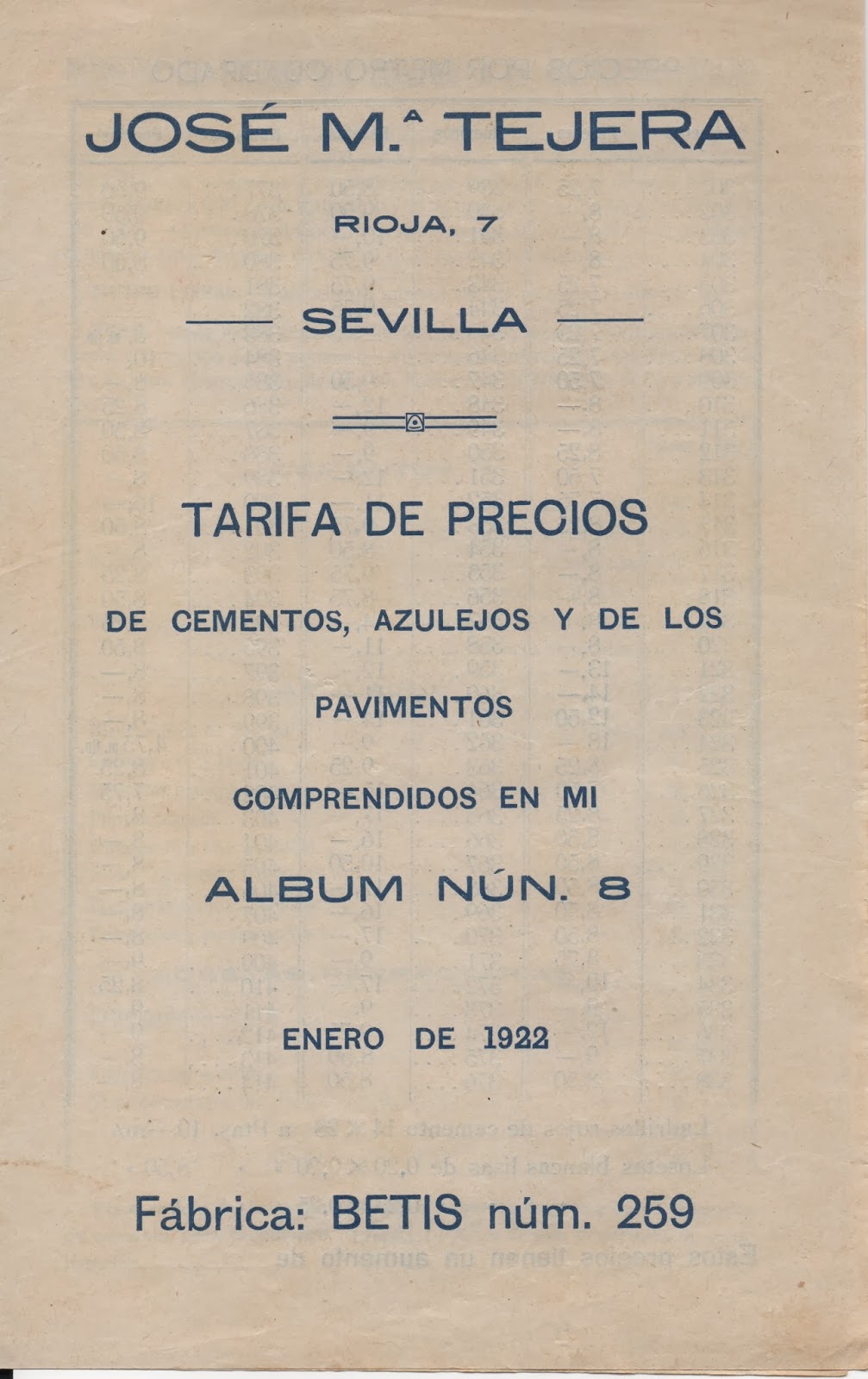
Since I have the catalogue - and you readers who have my book as well -
we can compare the prices with the designs :-))
Da ich den Katalog besitze - und ihr, meine Leser, die mein Buch besitzen, auch -
können wir die Preise mit den Designs vergleichen :-))
Como yo tengo el catálogo - y vosotros lectores, que tienen mi libro también -
podemos comparar los precios con los diseños :-))

Tuesday, August 6, 2013
Minton Hollins Tileworks (part II)
 |
| pen drawing by Neville Malkin - May 1976 |
I keep citing from the same source as before:
"If we could go back to the latter part of the 19th century and were able to enter through the gateway into the inner precinct, we would have been confronted at first by the offices; ascending the staircase, we would have been surprised by the walls which were covered with tiles of various colours and designs, all bearing the firm's monogram as their central ornament. There were examples in every passage, at every turning, and in every corner. Even the floors were inlaid with encaustic tiles, reminding us of classical tesselated pavements. The walls inside the offices were relieved with tiles, and on tables, mantelpieces, and in odd corners, you would have noticed the choice ornamentation, all reflecting the resources of the potter's art.
Behind the offices you would have entered a large open space lined with square workshops several storeys high, each a small self-contained unit. There were also 14 firing ovens of exceptional size, belching forth inky bellows of smoke; several large quantities of clay, in various colours, were heaped about the place."
Hier übersetze ich wieder aus der selben Quelle wie vorher (leider nicht so schön wie das Original):
"Wenn wir ins Ende des 19. Jahrhunderts zurückreisen und durch das Haupttor in den inneren Bereich eintreten könnten, wären wir zuest auf die Büros getroffen; beim Hochsteigen der Treppe hätten uns die Wände überrascht, die von Fliesen in unterschiedlichen Farben und Mustern bedeckt waren, die alle das Firmenmonogramm als zentrales Motiv trugen. Es gab Beispiele davon in jedem Flur, an jedem Treppenabsatz und in jeder Ecke. Sogar die Fußböden waren mit "encaustic tiles" gefliest, die an klassische Mosaikböden erinnerten. Die Wände in den Büros hatten Relieffliesen und auf Tischen, Kaminsimsen und in diversen Ecken hätte man ausgewählte Ornamente entdeckt, die allesamt die künstlerischen Möglichkeiten des Töpferhandwerks wiedergaben.
Hinter den Büros hätte man einen großen freien Platz betreten, der umrandet war von eckigen, mehrere Stockwerke hohen Werkstätten, jede eine abgeschossene Einheit. Es gab auch 14 aussergewöhnlich große Brennöfen, die tintenschwarze Rauchwolken ausrülpsten; mehrere große Berge von Ton in verschiedenen Farben waren über den Platz verteilt aufgehäuft."
Lo siento - no estoy capaz de traducir esta descripción... se trata del decorado del edificio como estaba en el fin del siglo XIX cuando se construyó - azulejos en todas partes...

Unfortunately I could not go back into the 19th century and were not even allowed to enter the building, but I did go through the gateway and behind the office building, where there is nowadays a vast empty space, party converted into a parking area.
Leider konnte ich ja nicht ins 19. Jahrhundert zurückgehen, ich durfte noch nicht einmal das Gebäude betreten, aber ich ging durch das große Portal hinter das Bürogebäude, wo es heute nur einen großen freien Platz gibt, der zum Teil als Parkplatz genutzt wird.
Desafortunadamente no pudo regresar al siglo XIX y también estaba prohibido a entar el edificio, pero sí pasé por el arco detrás las oficinas, donde hoy día hay un gran espacio partialmente convertido en parking.

But with a bit of fantasy you could imagine the workshop buildings... with tiled floors:
Aber mit ein bißchen Phantasie konnte man sich die Werkstattgebäude vorstellen... mit gefliesten Böden:
Pero con un poco de fantasía se pudo imaginar los edificios de talleres... con azulejos en el suelo:

... with rails for the displacement of materials or finished products:
.... mit Schienen um Rohmaterialien oder fertige Produkte zu bewegen:
... con vías para el desplacimiento de materiales o productos:

Wednesday, July 31, 2013
Minton Hollins Tileworks, Stoke-on-Trent (part I)
Finally it's time I started to tell you about my great time in "The potteries" - the area of Stoke-on-Trent, Staffordshire.
I knew that the famous tile company of Herbert Minton used to be there, so I went to the former adress to have a look.
Nun wird es endlich Zeit, dass ich von meiner Zeit in der Keramik-Gegend von Stoke-on-Trent, Staffordshire, erzähle.
Ich wußte, dass die berühmte Fliesenfabrik von Herbert Minton dort ihren Sitz hatte, also bin ich mal zu der alten Adresse gegangen um mich umzuschauen.
Por fin debe contaros sobre mi tiempo fantastico en "las cerámicas", en los alrededoresde Stoke-on-Trent, Staffordshire. Yo sabía que la fábrica famosa de Herbert Minton estuve por ahí y venía a la dirección antigua para hacer un vistazo.
On Shelton Old Road in Stoke is this enormous building:
In der Shelton Old Road in Stoke steht dieses imposante Gebäude:
En la calle Shelton Old Road se encuentra este edificio enorme:

today an office building, but still with the sign of the former company:
heute ein Bürogebäude, aber immer noch mit dem alten Firmenschild:
hoy día es un edificio de oficinas, pero lleva todavía el rótulo antiguo:
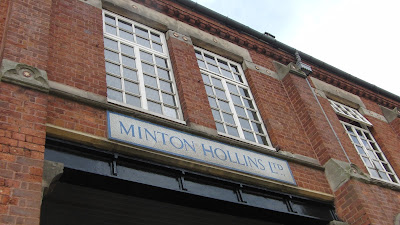
Minton Hollins & Co. was founded in 1845, when Herbert Minton entered into partnership with Michael Hollins. The tile factory was so successful that bigger premises were needed - those ones - built in 1869 by Charles Lynam.
Minton Hollins & Co. wurde 1845 gegründet, als Michael Hollins als Partner zu Herbert Minton kam. Die Fliesenfabrik war so erfolgreich, dass man schon bald größere Räumlichkeiten berauchte - dieses Gebäude wurde 1869 von Charles Lynam gebaut.
La empresa de Minton Hollins se fundó en 1845, cuando Michael Hollins entró en la empresa de Herbert Minton. La fábrica de azulejos fue tan exitosa, que pronto el sito antiguo quedó pequeño. Este edificio fue construido en 1869 de Charles Lynam.
Here I have found a great text, that I want to cite:
"Originally, tile-making was carried on in premises in Church Street, Stoke, but owing to the development of trade and the popularity of the tiles, the works proved to be inadequate.
The existing building, covering an area of more than seven acres and employing more than 800 people, was erected with sufficient resources to meet the most pressing demands. On the long, clean, red-brick frontage many examples of their tiles are featured in a variety of designs, set either into panels over the windows or individually placed at regular intervals.
Hier habe ich einen interessanten Text gefunden, den ich übersetzen möchte:
"Ursprünglich wurden die Fliesen in dem Firmengebäude in der Church Street in Stoke hergestellt, aber aufgrund der Entwicklung des Handels und der Beliebtheit der Fliesen erwies es sich als ungeeignet. Das jetzige Gebäude, das eine Fläche von mehr als sieben Morgen bedeckt und mehr als 800 Leute beschäftigte, wurde mit genügenden Ressourcen errichtet um den dringenden Bedarf zu decken. An der Fassade des langen roten Ziegelgebäudes sind viele Beispiele ihrer Fliesen in verschiedenen Mustern dargestellt, entweder in Paneelen über den Fenstern oder einzelne Muster in regelmäßigen Abständen."
Aquí he encontrado un texto interesante, que quiero traducir:
"Originalmente se fabricaban los azulejos en la Church Street (calle de la iglesia) en Stoke, pero debido al desarollo de la venta y la popularidad de los azulejos la fábrica quedó inadecuada. La casa actual, que cubre una superficie de más de siete acres y empleando más de 800 personas, fue construida con recursos suficientes para satisfacer las demandas más urgentes. En la fachada del largo rojo edificio de ladrillos hay muchas muestras de sus azulejos sobre las ventanas o como muestras individuales."

I knew that the famous tile company of Herbert Minton used to be there, so I went to the former adress to have a look.
Nun wird es endlich Zeit, dass ich von meiner Zeit in der Keramik-Gegend von Stoke-on-Trent, Staffordshire, erzähle.
Ich wußte, dass die berühmte Fliesenfabrik von Herbert Minton dort ihren Sitz hatte, also bin ich mal zu der alten Adresse gegangen um mich umzuschauen.
Por fin debe contaros sobre mi tiempo fantastico en "las cerámicas", en los alrededoresde Stoke-on-Trent, Staffordshire. Yo sabía que la fábrica famosa de Herbert Minton estuve por ahí y venía a la dirección antigua para hacer un vistazo.
On Shelton Old Road in Stoke is this enormous building:
In der Shelton Old Road in Stoke steht dieses imposante Gebäude:
En la calle Shelton Old Road se encuentra este edificio enorme:

today an office building, but still with the sign of the former company:
heute ein Bürogebäude, aber immer noch mit dem alten Firmenschild:
hoy día es un edificio de oficinas, pero lleva todavía el rótulo antiguo:

Minton Hollins & Co. was founded in 1845, when Herbert Minton entered into partnership with Michael Hollins. The tile factory was so successful that bigger premises were needed - those ones - built in 1869 by Charles Lynam.
Minton Hollins & Co. wurde 1845 gegründet, als Michael Hollins als Partner zu Herbert Minton kam. Die Fliesenfabrik war so erfolgreich, dass man schon bald größere Räumlichkeiten berauchte - dieses Gebäude wurde 1869 von Charles Lynam gebaut.
La empresa de Minton Hollins se fundó en 1845, cuando Michael Hollins entró en la empresa de Herbert Minton. La fábrica de azulejos fue tan exitosa, que pronto el sito antiguo quedó pequeño. Este edificio fue construido en 1869 de Charles Lynam.
Here I have found a great text, that I want to cite:
"Originally, tile-making was carried on in premises in Church Street, Stoke, but owing to the development of trade and the popularity of the tiles, the works proved to be inadequate.
The existing building, covering an area of more than seven acres and employing more than 800 people, was erected with sufficient resources to meet the most pressing demands. On the long, clean, red-brick frontage many examples of their tiles are featured in a variety of designs, set either into panels over the windows or individually placed at regular intervals.
Hier habe ich einen interessanten Text gefunden, den ich übersetzen möchte:
"Ursprünglich wurden die Fliesen in dem Firmengebäude in der Church Street in Stoke hergestellt, aber aufgrund der Entwicklung des Handels und der Beliebtheit der Fliesen erwies es sich als ungeeignet. Das jetzige Gebäude, das eine Fläche von mehr als sieben Morgen bedeckt und mehr als 800 Leute beschäftigte, wurde mit genügenden Ressourcen errichtet um den dringenden Bedarf zu decken. An der Fassade des langen roten Ziegelgebäudes sind viele Beispiele ihrer Fliesen in verschiedenen Mustern dargestellt, entweder in Paneelen über den Fenstern oder einzelne Muster in regelmäßigen Abständen."
Aquí he encontrado un texto interesante, que quiero traducir:
"Originalmente se fabricaban los azulejos en la Church Street (calle de la iglesia) en Stoke, pero debido al desarollo de la venta y la popularidad de los azulejos la fábrica quedó inadecuada. La casa actual, que cubre una superficie de más de siete acres y empleando más de 800 personas, fue construida con recursos suficientes para satisfacer las demandas más urgentes. En la fachada del largo rojo edificio de ladrillos hay muchas muestras de sus azulejos sobre las ventanas o como muestras individuales."

Sunday, July 21, 2013
Addition to the last post
In addition to the last post and especially for William Buyok:
another photo of the same pattern:
Als Ergänzung zu dem letzten Post - ein weiteres Beispiel wie das gleiche Muster angewendet wurde:
En adición a mi último post - otra muestra del mismo diseño:
another photo of the same pattern:
Als Ergänzung zu dem letzten Post - ein weiteres Beispiel wie das gleiche Muster angewendet wurde:
En adición a mi último post - otra muestra del mismo diseño:
 |
| Window protection, Stoke-on-Trent, England, XIX th century |
Saturday, June 1, 2013
A pattern through the centuries
A while ago I was in Córdoba and saw this pattern:
Vor kurzem war ich in Córdoba, wo ich dieses Muster gesehen habe:
 |
| Synagoge Córdoba, ca. XVI th century |
In der Mezquita war eine kleine Ausstellung mit frühchristlichen Funden von dieser Stelle bevor das islamische Gebäude errichtet wurde. Dieses Muster fiel mir auf:
En la Mezquita estuve una pequeña exposición con los restos del templo cristiano que se encontraba aquí. Vi este diseño:
 |
| Basílica de San Vicente Mártir, Cordoba, V th century |
Nachdem ich auf verschränkte Kreise aufmerksam geworden war, schaute ich auch genauer auf den Boden:
Después de interesarme por los círculos conectados, miré el suelo delante de mis pies:
 |
| Hydrant, XXI century |
Und dann fiel mir ein, dass ich römische Mosaiken in Sevilla gesehen habe:
Y por fin recordé los mosaicos romanos que he visto en Sevilla:
 |
| Plaza Encarnación, Sevilla, ca. I century |
Und warum schreibe ich überhaupt darüber? Weil ich dieses Muster gut kenne :-))
¿Y Porque estoy escribiendo sobre este? Porque conozco el diseño muy bien :-))
 |
| catalogue González Hermanos, 1917 |
P.S. Und erzählt mir nicht, dass die Muster verschieden sind; manche muss man diagonal drehen, um es zu erkennen!
P.D. ¡ Y no me digas que los diseños son diferentes, girarlos por 45° y veras!
Monday, May 27, 2013
More information on the TEJERA book
I think I should tell you a little more about the book I wrote:
It is the biography of one of the most famous cement-tile-maker from Sevilla and about his companies. I also included a brief history of different floor types and a description how those tiles were produced. Unfortunately for you English-speaker (and for me as a writer), I decided it had to be in Spanish. But the 88 pages of text contain a lot of images - about 150, like old newspaper ads, photos of the family, scans of my tiles. As appendix I have included the whole tile-catalogue of 1907 with fantastic designs, 59 pages in total, plus 9 pages with the family tree and a map of Sevilla where I marked the relevant places. I think the catalogue alone makes it worthwhile to obtain.
Ich denke ich sollte etwas mehr erzaehlen ueber das Buch, das ich gescchrieben habe. Es ist die Biographie eines der beruehmtesten Zementfliesen-Produzenten aus Sevilla und seiner Firmen. Ausserdem habe ich eine kurze Ggeschichte verschiedener farbiger Bodenbelaege eingefuegt, sowie den Fabrikationsprozess der Fliesen. Ungluecklicherweise fuer euch deutsche Leser (und fuer mich als Schreiber) habe ich mich entschieden es in Spanish zu schreiben. Aber die 88 Seiten Text enthalten ca. 150 Abbildungen; alte Zeitungsanzeigen, Familienfotos, Fotos meiner Sammlungsstücke; dazu weitere 59 Seiten mit einem wunderschoenen Fliesenmusterkatalog von 1907, 9 Seiten Stammbaum der Familie Tejera und einen alten Stadtplan von Sevilla mit der Lage der beschriebenen Orte. Ich finde schon alleine der Katalog ist es wert das Buch zu besitzen.
Pienso que debe explicar un poco mas sobre el libro que he escrito. Se trata de la biografia de uno de los mas famosos fabricantes de mosaicos hidraulicos y su empresas. Tambien hay el arbol genealogico de la familia Tejera Teran: los hijos, nietos y biznietos. Como es en Espanol, Ustedes puede hojear su mismo y ver que hay muchos imagenes en el texto y todo el catalogo maravilloso del ano 1907. (Perdone: Estoy escribiendo desde un teclado ingles y no encuentra los accentos.)
It is the biography of one of the most famous cement-tile-maker from Sevilla and about his companies. I also included a brief history of different floor types and a description how those tiles were produced. Unfortunately for you English-speaker (and for me as a writer), I decided it had to be in Spanish. But the 88 pages of text contain a lot of images - about 150, like old newspaper ads, photos of the family, scans of my tiles. As appendix I have included the whole tile-catalogue of 1907 with fantastic designs, 59 pages in total, plus 9 pages with the family tree and a map of Sevilla where I marked the relevant places. I think the catalogue alone makes it worthwhile to obtain.
Ich denke ich sollte etwas mehr erzaehlen ueber das Buch, das ich gescchrieben habe. Es ist die Biographie eines der beruehmtesten Zementfliesen-Produzenten aus Sevilla und seiner Firmen. Ausserdem habe ich eine kurze Ggeschichte verschiedener farbiger Bodenbelaege eingefuegt, sowie den Fabrikationsprozess der Fliesen. Ungluecklicherweise fuer euch deutsche Leser (und fuer mich als Schreiber) habe ich mich entschieden es in Spanish zu schreiben. Aber die 88 Seiten Text enthalten ca. 150 Abbildungen; alte Zeitungsanzeigen, Familienfotos, Fotos meiner Sammlungsstücke; dazu weitere 59 Seiten mit einem wunderschoenen Fliesenmusterkatalog von 1907, 9 Seiten Stammbaum der Familie Tejera und einen alten Stadtplan von Sevilla mit der Lage der beschriebenen Orte. Ich finde schon alleine der Katalog ist es wert das Buch zu besitzen.
Pienso que debe explicar un poco mas sobre el libro que he escrito. Se trata de la biografia de uno de los mas famosos fabricantes de mosaicos hidraulicos y su empresas. Tambien hay el arbol genealogico de la familia Tejera Teran: los hijos, nietos y biznietos. Como es en Espanol, Ustedes puede hojear su mismo y ver que hay muchos imagenes en el texto y todo el catalogo maravilloso del ano 1907. (Perdone: Estoy escribiendo desde un teclado ingles y no encuentra los accentos.)
Thursday, April 11, 2013
Tuesday, April 9, 2013
Nearly finished!
Last saturday I had the presentation of my cement-tile book in Sevilla. It was a great day for me, with friends who came to celebrate with me.
El sábado pasado fue la presentación de mi libro sobre mosaicos hidráulicos en Sevilla. Estuve un día maravilloso para me con amigos que venían para celebrar conmigo.
Letzten Samstag war die Presentation meines Zementfliesenbuches in Sevilla. Es war ein großer Tag für mich mit vielen Freunden, die gekommen sind um mit mir zu feiern.

But alas, the work is not finished yet!
I have been shown this floor in Sevilla, when I didn´t have my camera with me, but since this is a floor from Tejera, I have to include a photo.
¡Pero lamentablemente el trabajo ya no está terminado! Me ha mostrado este suelo de Tejera, cuando no llevaba camera, y ahora debería incluir esta foto.
Aber leider ist das Werk noch nicht beendet! Diesen Fußboden von Tejera hat man mir letzte Woche gezeigt, als ich keine Kamera dabeihatte. Aber nun muss ich dieses Foto noch einfügen.

Do you realize this design is made from two different tiles? And obviously the floor tiler had some difficulties...
¿Reconocéis que el diseño esta formado por dos losetas diferentes? Y el colocador de las baldosas tenía sus dificultades...
Erkennt ihr, dass das Muster aus zwei verschiedenen Fliesen besteht? Und offensichtlich hatte auch der Fliesenleger seine Schwierigkeiten damit...
El sábado pasado fue la presentación de mi libro sobre mosaicos hidráulicos en Sevilla. Estuve un día maravilloso para me con amigos que venían para celebrar conmigo.
Letzten Samstag war die Presentation meines Zementfliesenbuches in Sevilla. Es war ein großer Tag für mich mit vielen Freunden, die gekommen sind um mit mir zu feiern.

But alas, the work is not finished yet!
I have been shown this floor in Sevilla, when I didn´t have my camera with me, but since this is a floor from Tejera, I have to include a photo.
¡Pero lamentablemente el trabajo ya no está terminado! Me ha mostrado este suelo de Tejera, cuando no llevaba camera, y ahora debería incluir esta foto.
Aber leider ist das Werk noch nicht beendet! Diesen Fußboden von Tejera hat man mir letzte Woche gezeigt, als ich keine Kamera dabeihatte. Aber nun muss ich dieses Foto noch einfügen.

Do you realize this design is made from two different tiles? And obviously the floor tiler had some difficulties...
¿Reconocéis que el diseño esta formado por dos losetas diferentes? Y el colocador de las baldosas tenía sus dificultades...
Erkennt ihr, dass das Muster aus zwei verschiedenen Fliesen besteht? Und offensichtlich hatte auch der Fliesenleger seine Schwierigkeiten damit...
Wednesday, March 27, 2013
Museum pieces
Here in the Museum of History of Valencia is an exhibition about the Mercado Central, the market building built 1910-1928 in plain modernism style. The exhibition is about the restauration works of the metal structure, stained glass windows, ceramic tiles, brick pillars etc. and during the renovation they also found some cement tiles under a layer of other flooring.
Anyway, this is the first time I see cement tiles displayed in a museum!
Aquí en el museo de la historia de Valencia hay una exposición sobre el Mercado Central, construido 1910-1928 en pleno estilo de modernismo. La exposición está sobre la restauración del edificio, el hierro forjado, vidrieras, azulejos, pilares de ladrillo etc. y durante la renovación se han encontrado también algunas losetas hidráulicas - bajo otros pavimentos.
¡Es la primera vez que veo mosaicos hidráulicos en un museo!
Hier im Museum der Geschichte von Valencia ist eine Sonderausstellung über den Mercado Central, die Markthalle, die von 1910-1928 im puren Jugendstil erbaut wurde. Die Ausstellung behandelt die Renovierungsarbeiten der Eisenkonstruktion, Bleiglasfenster, Keramikfliesen, Ziegelsäulen etc. und während der Arbeiten fand man auch einige Zementfliesen unter einer Schicht von anderem Fußbodenbelag.
Immerhin, dies ist das erste mal, das ich Zementfliesen in einem Museum sehe!


Anyway, this is the first time I see cement tiles displayed in a museum!
Aquí en el museo de la historia de Valencia hay una exposición sobre el Mercado Central, construido 1910-1928 en pleno estilo de modernismo. La exposición está sobre la restauración del edificio, el hierro forjado, vidrieras, azulejos, pilares de ladrillo etc. y durante la renovación se han encontrado también algunas losetas hidráulicas - bajo otros pavimentos.
¡Es la primera vez que veo mosaicos hidráulicos en un museo!
Hier im Museum der Geschichte von Valencia ist eine Sonderausstellung über den Mercado Central, die Markthalle, die von 1910-1928 im puren Jugendstil erbaut wurde. Die Ausstellung behandelt die Renovierungsarbeiten der Eisenkonstruktion, Bleiglasfenster, Keramikfliesen, Ziegelsäulen etc. und während der Arbeiten fand man auch einige Zementfliesen unter einer Schicht von anderem Fußbodenbelag.
Immerhin, dies ist das erste mal, das ich Zementfliesen in einem Museum sehe!


Thursday, February 7, 2013
More tile research
Sorry about the long delay - I am still busy with my "tile-maker-book", but I finally see light at the end of the tunnel. In the biography about José María Tejera and his company, I have now reached the final part about his widow.
Bitte entschuldigt die lange Blogpause - ich bin immer noch beschäftigt mit meinem "Zementfliesen-Fabrikanten-Buch", aber endlich sehe ich Licht am Ende des Tunnels. In der Biografie über José María Tejera und seine Firma, bin ich mittlerweile schon bei seiner Witwe angelangt.
Perdonaos el largo silencio, estoy todavía ocupado con mi libro sobre el fabricante de mosaicos, pero por fin veo luz al final del túnel. En la biografía sobre José María Tejera he llegado al parte final sobre la viuda.

I hope that in my next post - maybe in a month - I can announce the "birth" of the book!
Ich hoffe in meinem nächsten Post - vielleicht in etwa einem Monat - kann ich die "Geburt" des Buches vermelden!
¡Espero que en mi próximo post - quizás en un mes - puedo anunciar el "nacimiento" del libro!
Bitte entschuldigt die lange Blogpause - ich bin immer noch beschäftigt mit meinem "Zementfliesen-Fabrikanten-Buch", aber endlich sehe ich Licht am Ende des Tunnels. In der Biografie über José María Tejera und seine Firma, bin ich mittlerweile schon bei seiner Witwe angelangt.
Perdonaos el largo silencio, estoy todavía ocupado con mi libro sobre el fabricante de mosaicos, pero por fin veo luz al final del túnel. En la biografía sobre José María Tejera he llegado al parte final sobre la viuda.

I hope that in my next post - maybe in a month - I can announce the "birth" of the book!
Ich hoffe in meinem nächsten Post - vielleicht in etwa einem Monat - kann ich die "Geburt" des Buches vermelden!
¡Espero que en mi próximo post - quizás en un mes - puedo anunciar el "nacimiento" del libro!
Monday, October 29, 2012
Framed at last!
Do you remember the tile I found in Puerto Real ?(I wrote about it here). Now, after cleaning and framing it looks like this:
Erinnert ihr euch an die Fliese, die ich in Puerto Real gefunden habe? (ich habe hier darüber geschrieben) Nachdem sie gereinigt und endlich auch gerahmt ist, sieht sie so aus:
¿Recordáis la loseta, que he encontrado en Puerto Real? (he escrito aquí sobre esta). Ahora, después de limpiarla y finalmente enmarcarla, es así:
 And thanks to all knowing (no joke!) collector Jordi Griset, I can tell you now, that it appeared for the first time in a catalogue of Escofet, Fortuny y Cía in 1891 and was designed by Josep Pascó.
Und dank des allwissenden (kein Witz!) Sammlers Jordi Griset kann ich euch auch jetzt mitteilen, dass die Fliese zum ersten Mal 1891 in einem Katalog von Escofet, Fortuny y Cía als Design von Josep Pascó auftauchte.
Y gracias al coleccionista omnisciente (¡no broma!) Jordi Griset puedo informar os, que la posta aparecía por primera vez en un catálogo de Escofet, Fortuny y Cía de 1891 y es un diseño de Josep Pascó.

Erinnert ihr euch an die Fliese, die ich in Puerto Real gefunden habe? (ich habe hier darüber geschrieben) Nachdem sie gereinigt und endlich auch gerahmt ist, sieht sie so aus:
¿Recordáis la loseta, que he encontrado en Puerto Real? (he escrito aquí sobre esta). Ahora, después de limpiarla y finalmente enmarcarla, es así:

Und dank des allwissenden (kein Witz!) Sammlers Jordi Griset kann ich euch auch jetzt mitteilen, dass die Fliese zum ersten Mal 1891 in einem Katalog von Escofet, Fortuny y Cía als Design von Josep Pascó auftauchte.
Y gracias al coleccionista omnisciente (¡no broma!) Jordi Griset puedo informar os, que la posta aparecía por primera vez en un catálogo de Escofet, Fortuny y Cía de 1891 y es un diseño de Josep Pascó.

Friday, October 5, 2012
First evidence...
... of a tile facotry in Antequera.
Last week I found a first tile with a logo from Antequera.
Letzte Woche habe ich die erste Fliese mit Firmenstempel aus Antequera gefunden.
La semana pasa he encontrado la primera baldosa con sello de una fábrica de Antequera.

Of course I had to have a look in the municipal archive and found this advertisement from 1929:
Natürlich musste ich im Stadtarchiv nachschauen und fand diese Anzeige von 1929:
Por supuesto debía buscar en el archivo municipal y encontré el siguiente anuncio del año 1929:

Finally I had to have a look at the mentioned street:
Schließlich musste ich auch die angegeben Strasse aufsuchen:
Y por fin debía ir a la calle mencionada:

This is No. 3 and not 8; so obviously Manuel Pozo moved from one side of the street to the other and only carried on with the carpenter´s workshop.
Dies ist allerdings Hausnummer 3 und nicht 8; also ist Manuel Pozo wohl von einer Seite der Strasse auf die andere gezogen und hat dort nur noch die Schreinerei betrieben.
Este es el número 3 y no 8; Manuel Pozo debería haber trasladarse de un lado de la calle al otro y solo seguía con la carpintería.
Last week I found a first tile with a logo from Antequera.
Letzte Woche habe ich die erste Fliese mit Firmenstempel aus Antequera gefunden.
La semana pasa he encontrado la primera baldosa con sello de una fábrica de Antequera.

Of course I had to have a look in the municipal archive and found this advertisement from 1929:
Natürlich musste ich im Stadtarchiv nachschauen und fand diese Anzeige von 1929:
Por supuesto debía buscar en el archivo municipal y encontré el siguiente anuncio del año 1929:

Finally I had to have a look at the mentioned street:
Schließlich musste ich auch die angegeben Strasse aufsuchen:
Y por fin debía ir a la calle mencionada:

This is No. 3 and not 8; so obviously Manuel Pozo moved from one side of the street to the other and only carried on with the carpenter´s workshop.
Dies ist allerdings Hausnummer 3 und nicht 8; also ist Manuel Pozo wohl von einer Seite der Strasse auf die andere gezogen und hat dort nur noch die Schreinerei betrieben.
Este es el número 3 y no 8; Manuel Pozo debería haber trasladarse de un lado de la calle al otro y solo seguía con la carpintería.
Saturday, September 22, 2012
Tile storage
I am always searching for possibilities to store more tiles.
Ich bin immer auf der Suche nach Möglichkeiten noch mehr Fliesen unterzubringen.
Estoy siempre buscando posibilidades a ubicar aún más losetas.
I had already shown you the wall displays, that my husband made for me (here).
Die Fliesengerüste an der Wand, die mir mein Mann gebaut hat, habe ich euch schon (hier) gezeigt.
Ya he mostrado a los andamios (aquí) que ha construido mi marido.
Last year I happened to find this revolving magazine rack on the street - a perfect display for yet another 25 tiles.
Letztes Jahr habe ich diesen Dreh-Zeitschriftenhalter auf der Strasse gefunden - perfekt für weitere 25 Fliesen.
El año pasado he encontrado este soporte giratorio de revistas en la calle - perfecto para 25 losetas más.

But there are still more tiles; and it is not good to just pile them up.
Aber ich habe noch mehr Fliesen und es ist nicht gut, sie einfach aufeinander zu stapeln.
Pero tengo más losetas y no sirve a solamente apilarlas.
On my last trip to IKEA I had an enlightenment: the RATIONELL VARIERA POT LID ORGANIZER!
Bei meinem letzten IKEA-Besuch kam mir die Erleuchtung: der RATIONELL VARIERA DECKELHALTER!
En mi último visita a IKEA tenía una iluminación: ¡el RATIONELL VARIERA SOPORTE PARA TAPAS!

Ich bin immer auf der Suche nach Möglichkeiten noch mehr Fliesen unterzubringen.
Estoy siempre buscando posibilidades a ubicar aún más losetas.
I had already shown you the wall displays, that my husband made for me (here).
Die Fliesengerüste an der Wand, die mir mein Mann gebaut hat, habe ich euch schon (hier) gezeigt.
Ya he mostrado a los andamios (aquí) que ha construido mi marido.
Last year I happened to find this revolving magazine rack on the street - a perfect display for yet another 25 tiles.
Letztes Jahr habe ich diesen Dreh-Zeitschriftenhalter auf der Strasse gefunden - perfekt für weitere 25 Fliesen.
El año pasado he encontrado este soporte giratorio de revistas en la calle - perfecto para 25 losetas más.

But there are still more tiles; and it is not good to just pile them up.
Aber ich habe noch mehr Fliesen und es ist nicht gut, sie einfach aufeinander zu stapeln.
Pero tengo más losetas y no sirve a solamente apilarlas.
On my last trip to IKEA I had an enlightenment: the RATIONELL VARIERA POT LID ORGANIZER!
Bei meinem letzten IKEA-Besuch kam mir die Erleuchtung: der RATIONELL VARIERA DECKELHALTER!
En mi último visita a IKEA tenía una iluminación: ¡el RATIONELL VARIERA SOPORTE PARA TAPAS!

Subscribe to:
Posts (Atom)